"Anti-aging" gets used so often it has nearly lost its meaning. So this piece pulls back the curtain on what aging actually is, not as marketing language, but as biology.
Aging is not caused by one thing. It is a collection of biological changes happening throughout the body over time. Scientists describe these processes as the Hallmarks of Aging, and understanding them has changed how I think about skin longevity, and which interventions are actually worth a patient's time.
Aging happens at multiple levels
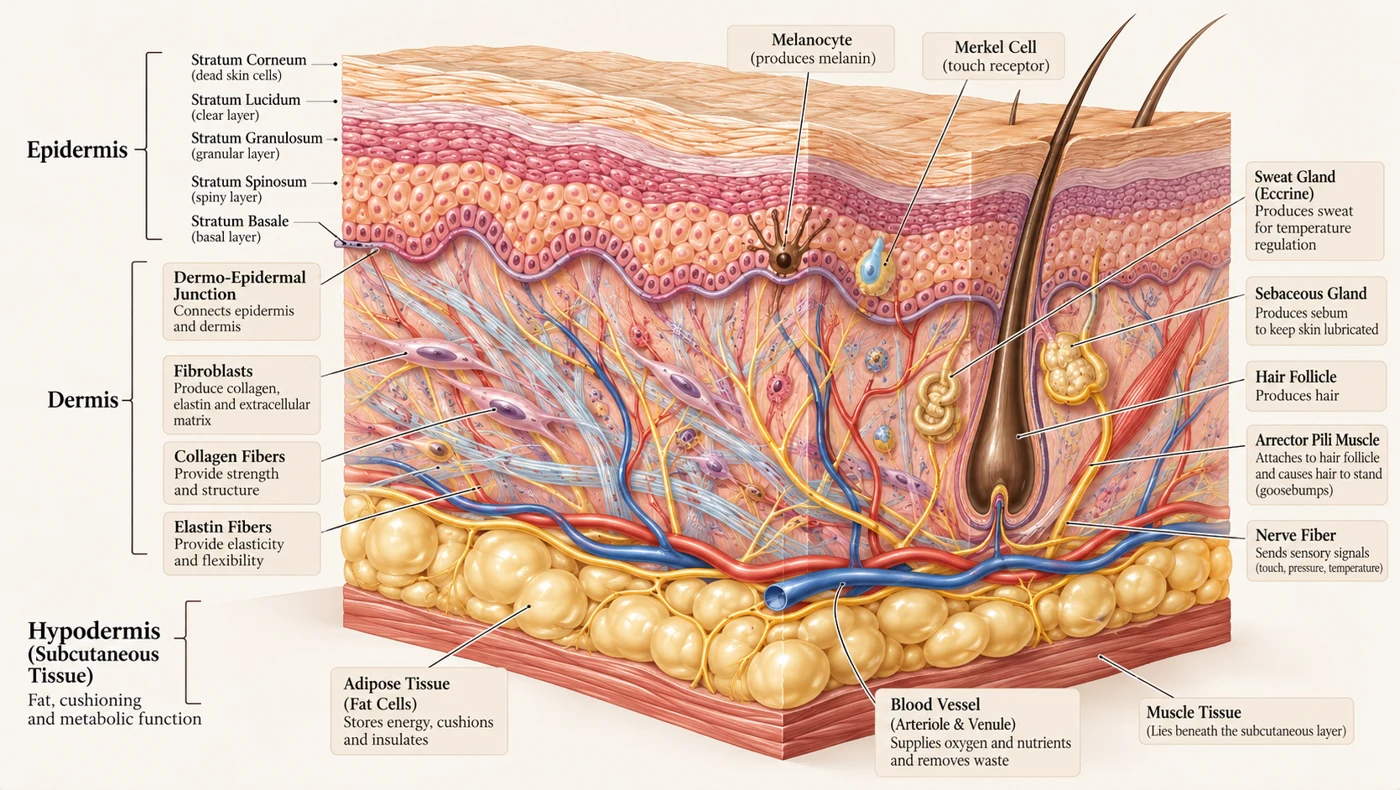
It is easy to focus on what we can see: wrinkles, loss of firmness, changes in pigmentation, thinner or less resilient skin. But those are visible consequences of deeper biological changes. The hallmarks give us a framework for understanding what is happening underneath the surface.
The 12 hallmarks of aging
- Genomic instability. Damage accumulates in our DNA over time.
- Telomere attrition. Protective chromosome ends gradually shorten.
- Epigenetic alterations. The way genes are regulated changes with age. This is the basis of epigenetic clocks, which I cover in a separate piece.
- Loss of proteostasis. Cells become less efficient at maintaining healthy proteins, including collagen and elastin.
- Disabled macroautophagy. The cellular recycling system becomes less effective.
- Deregulated nutrient sensing. The systems that sense and respond to nutrients become altered.
- Mitochondrial dysfunction. Our cellular energy factories slow down, leaving less fuel for repair and renewal.
- Cellular senescence. Often called zombie cells, these stop dividing but do not die. They linger and send out inflammatory signals that damage the healthy cells around them.
- Stem cell exhaustion. Fewer fresh cells are available to replace what is lost.
- Altered intercellular communication. Cells signal to each other differently as we age.
- Chronic inflammation. Low grade inflammation, sometimes called inflammaging, becomes persistent.
- Dysbiosis. Changes in the microbiome can affect health and aging.
"Your skin does not age in isolation."
Your skin does not age in isolation
Changes in cellular energy, inflammation, DNA regulation, stem cell function, and tissue repair all influence how your skin behaves over time. Hormonal shifts, especially through perimenopause and menopause, along with insulin resistance and inflammation, are internal drivers of the same changes people try to treat topically.
That is why I do not think about skin longevity as simply treating wrinkles. I am interested in how well the tissue functions, repairs, and responds over time. Treating the surface without addressing what is underneath is why so many products underdeliver.
What this looks like clinically
- Less collagen. The dermis gradually loses structural support.
- Less elasticity. Elastic fibers become altered and less effective.
- Slower repair. Tissue regeneration and wound healing become less efficient.
- More inflammation. Chronic inflammatory signaling affects skin function.
- Changes in pigmentation. Cellular and environmental factors alter how pigmentation behaves.
- Changes in barrier function. Skin becomes less resilient and more prone to dryness and irritation.
So what do I actually do with this information?
I do not try to treat all 12 hallmarks individually. I use them as a framework for understanding how we age and where we may actually be able to intervene, starting with the fundamentals: sleep, exercise, nutrition, metabolic health, stress, relationships, and environmental exposures. Then, when appropriate, targeted dermatologic treatments support the tissue itself.
Optimize the patient, then regenerate the tissue. That is the approach I take to skin longevity. The goal is not to chase a single serum or device promising to reverse the clock. It is understanding which hallmark is driving what you are seeing, and sequencing interventions accordingly.
The takeaway
Aging is biology, not just appearance. The goal is not to make you look 25 again. It is to support healthy skin that functions well at every age.